Introduction
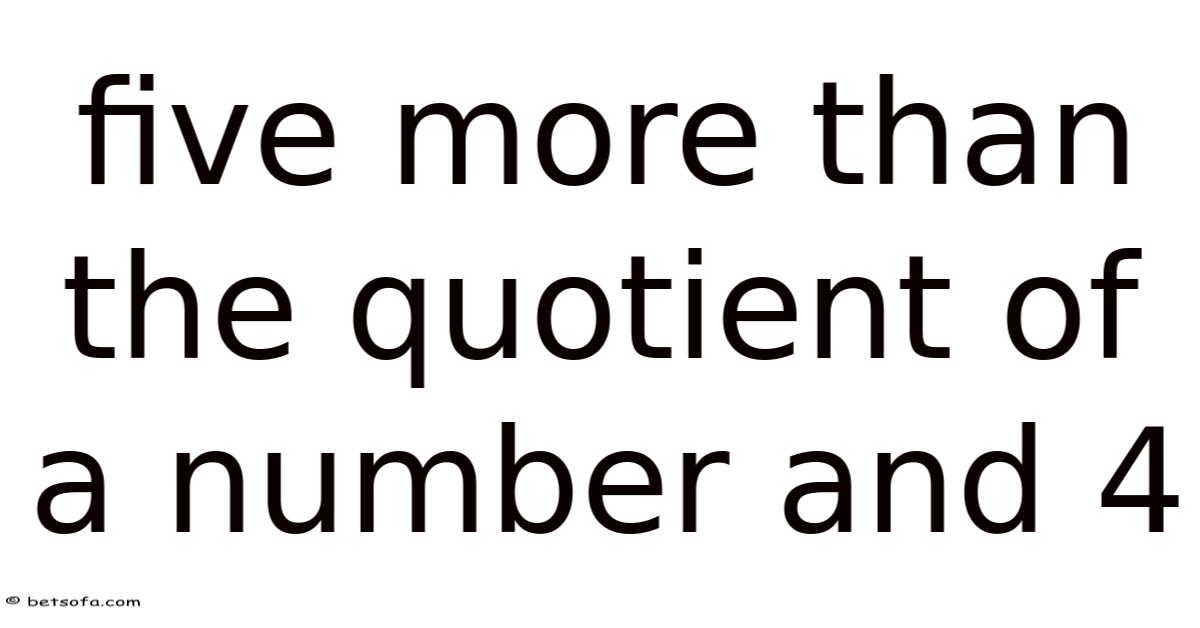
When you hear the phrase “five more than the quotient of a number and 4,” you might picture a simple arithmetic recipe: take a number, divide it by 4, then add 5. On top of that, this expression appears frequently in algebra, word problems, and real‑world calculations where a base quantity is scaled down and then shifted upward. Understanding how to translate verbal descriptions into algebraic form is a foundational skill that bridges everyday reasoning and more advanced mathematics. In this article we will unpack the meaning of the phrase, break it down step by step, illustrate it with concrete examples, explore the underlying theory, highlight common pitfalls, and answer frequently asked questions. By the end, you’ll be able to recognize, manipulate, and apply the expression ( x ÷ 4 ) + 5 with confidence Small thing, real impact..
Detailed Explanation
The core of the statement is the quotient of a number and 4. In mathematics, a quotient is the result you obtain when one number (the dividend) is divided by another (the divisor). Here, the dividend is an unspecified number—commonly represented by a variable such as x—and the divisor is the constant 4. Thus, the quotient is written as x ⁄ 4 or x ÷ 4.
The phrase “five more than” indicates an addition operation that follows the quotient. Also, consequently, the complete algebraic expression becomes (x ⁄ 4) + 5. Worth adding: “More than” signals that we increase the preceding quantity by five units. Parentheses are optional here because division has higher precedence than addition, but they help point out the intended order: first divide, then add five.
This expression is linear in x; its graph is a straight line with a slope of 1⁄4 and a y‑intercept of 5. Because of that, changing the input number shifts the output proportionally, while the constant + 5 lifts the entire line upward on the coordinate plane. Recognizing this structure allows us to solve for x when the expression equals a given value, or to evaluate the expression for any specific x we choose.
Step‑by‑Step Concept Breakdown
To internalize the expression, follow these logical steps:
- Identify the unknown number – Choose a symbol, most often x, to stand for “a number.”
- Form the quotient – Divide x by 4. Write this as x ⁄ 4 (or x ÷ 4).
- Apply “five more than” – Add 5 to the result from step 2. The final form is (x ⁄ 4) + 5.
- Check the order of operations – Because division outranks addition, you could also write x ⁄ 4 + 5 without parentheses, but keeping them clarifies intent, especially for beginners.
- Interpret the result – The output tells you what you get after scaling the original number down to one‑fourth of its size and then raising it by five units.
If you need to solve for x given a specific output, reverse the steps: subtract 5, then multiply by 4. Take this: if (x ⁄ 4) + 5 = 12, first compute 12 − 5 = 7, then multiply 7 × 4 = 28, yielding x = 28 Nothing fancy..
Real Examples
Example 1: Evaluating the Expression
Suppose the number is 20.
- Quotient: 20 ÷ 4 = 5
- Add five: 5 + 5 = 10
Thus, five more than the quotient of 20 and 4 equals 10.
Example 2: Solving for the Unknown
A word problem states: “When you take a number, divide it by 4, and then add 5, you get 18. What is the number?”
Set up the equation: (x ⁄ 4) + 5 = 18
- Subtract 5: x ⁄ 4 = 13
- Multiply by 4: x = 52
The original number is 52.
Example 3: Practical Application
Imagine a recipe that calls for one‑fourth of a cup of sugar plus an extra 5 tablespoons for sweetness. If you let x represent the total tablespoons of sugar you start with, the amount you actually use is (x ⁄ 4) + 5 tablespoons. For x = 40 tablespoons (2.5 cups), the calculation gives (40 ⁄ 4) + 5 = 10 + 5 = 15 tablespoons used in the recipe.
These examples show how the expression translates abstract algebra into tangible situations, from simple arithmetic to everyday cooking or budgeting scenarios Which is the point..
Scientific or Theoretical Perspective
From a theoretical standpoint, the expression (x ⁄ 4) + 5 exemplifies an affine transformation of the variable x. An affine transformation combines a linear scaling (here, multiplication by 1⁄4) with a translation (addition of 5). In linear algebra, such transformations preserve points, straight lines, and planes; they are fundamental in computer graphics, physics, and data normalization The details matter here. And it works..
The slope 1⁄4 indicates that for every increase of 4 units in x, the output rises by exactly 1 unit. The y‑intercept of 5 tells us the output value when x = 0—that is, even if you start with nothing, the process still yields 5 due to the constant addition. Here's the thing — this dual behavior—scaling plus shifting—is ubiquitous in modeling real‑world phenomena where a baseline offset exists (e. g., temperature conversions, tax brackets, or signal processing).
People argue about this. Here's where I land on it.
Understanding the expression as an affine map also aids in solving systems of equations: if you encounter multiple expressions of the form (x ⁄ k) + c, you can treat each as a line and find intersections analytically or graphically Worth keeping that in mind..
Common Mistakes or Misunderstandings
Common Mistakes or Misunderstandings
1. Reversing the Order of Operations
The most frequent error is adding 5 before dividing by 4. Because the expression is written as ((x \div 4) + 5), the division must happen first. A student might incorrectly compute (x \div (4 + 5)) or ((x + 5) \div 4), fundamentally changing the relationship between the input and output. Always remember: grouping symbols (parentheses) and the standard order of operations (PEMDAS/BODMAS) dictate that division precedes addition here.
2. Misinterpreting “Five More Than”
In word problems, the phrase “five more than the quotient” signals addition after the division is complete. Some learners mistakenly interpret “more than” as a cue to add to the divisor (e.g., (x \div (4 + 5))) or the dividend (((x + 5) \div 4)). Linguistically, “more than” modifies the result of the preceding operation, not the components inside it Most people skip this — try not to..
3. Algebraic Reversal Errors (Inverse Operations)
When solving for (x), the inverse operations must be applied in the reverse order of the original expression. The original order is: divide by 4, then add 5. The reverse order is: subtract 5, then multiply by 4. A common slip is multiplying by 4 first (yielding (x + 20 = \text{target} \times 4)), which distributes the multiplication incorrectly across the addition. Another error is subtracting 5 but forgetting to multiply by 4, leaving the answer as (x/4) rather than (x) Less friction, more output..
4. Ignoring the Domain in Context
In practical scenarios (like the recipe example), (x) often represents a physical quantity that cannot be negative. While the mathematical function accepts all real numbers, a “negative number of tablespoons” is nonsensical. Forgetting to state domain restrictions (e.g., (x \ge 0)) can lead to mathematically correct but practically impossible solutions.
5. Confusing Slope and Intercept in Graphical Analysis
When graphing (y = \frac{1}{4}x + 5), students sometimes confuse the slope ((\frac{1}{4})) with the (x)-intercept, or the (y)-intercept (5) with the slope. Remember: the slope is the rate of change (rise over run), while the intercept is the starting value on the vertical axis. Plotting the intercept at ((0, 5)) and using the slope to find a second point (e.g., run 4, rise 1 to ((4, 6))) avoids this confusion Simple, but easy to overlook. Simple as that..
Conclusion
The expression ((x \div 4) + 5) serves as a deceptively simple gateway to core algebraic thinking. Here's the thing — it encapsulates the hierarchy of operations, the mechanics of inverse functions, the geometry of affine transformations, and the art of translating language into symbolic logic. Plus, whether you are scaling a recipe, debugging a linear algorithm, or solving for an unknown in a word problem, the principles remain identical: respect the order of operations, apply inverse steps in reverse, and always verify that your solution makes sense within the problem's context. Mastering this foundational pattern builds the intuition necessary to tackle far more complex mathematical landscapes, proving that even the smallest expressions carry the weight of big ideas.
