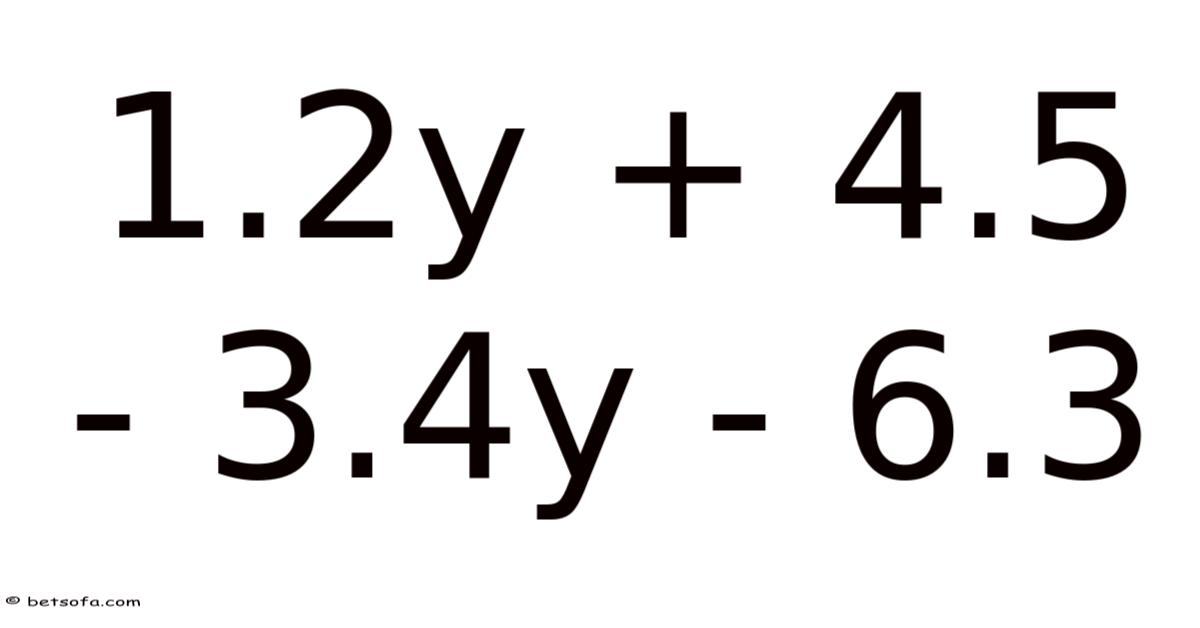
1.2y + 4.5 - 3.4y - 6.3: A Complete Guide to Simplifying Algebraic Expressions
Introduction
The expression 1.Plus, whether you are a student encountering algebra for the first time or a professional brushing up on foundational math, understanding how to simplify expressions like 1. That said, at first glance, it may appear to be a jumble of numbers, variables, and operators, but beneath the surface lies a structured and logical mathematical process that transforms it into a clean, concise form. Simplifying algebraic expressions is one of the most essential skills in mathematics, serving as the foundation for everything from solving equations to modeling real-world phenomena in science, engineering, and finance. 2y + 4.5 - 3.4y - 6.Still, 2y + 4. Here's the thing — 3 is a classic example of a linear algebraic expression that can be simplified using fundamental algebraic techniques. So 5 - 3. Now, 4y - 6. In this article, we will explore exactly what this expression represents, how to simplify it step by step, why the process works the way it does, and where these skills apply in practical life. 3 is a critical building block in your mathematical toolkit Most people skip this — try not to..
Understanding the Components of the Expression
Before diving into the simplification process, it is important to understand what each part of the expression 1.Day to day, 5, -3. 2y + 4.4y, and -6.3 represents. An algebraic expression is made up of terms, which are the individual pieces separated by addition or subtraction signs. 4y - 6.In practice, 5 - 3. On top of that, 2y**, **+4. In this case, the expression contains four distinct terms: 1.3.
Each term can be classified into one of two categories: variable terms and constant terms. A variable term contains a letter (in this case, y) that represents an unknown or changing value. The coefficient is the numerical factor multiplied by the variable — so in 1.2y, the coefficient is 1.2, and in -3.Which means 4y, the coefficient is -3. 4. Constant terms, on the other hand, are pure numbers without any variables attached. Here, 4.5 and -6.3 are the constant terms. Recognizing these components is the first and most crucial step in simplifying any algebraic expression, because the entire simplification process revolves around grouping and combining like terms It's one of those things that adds up. Nothing fancy..
What Are Like Terms and Why Do They Matter?
Like terms are terms that share the exact same variable part, including the same variable raised to the same power. To give you an idea, 1.2y and -3.4y are like terms because they both contain the variable y raised to the first power. Similarly, 4.5 and -6.3 are like terms because they are both constants with no variable component. Terms like 1.2y and 4.5 are unlike terms and cannot be combined through addition or subtraction Not complicated — just consistent..
The concept of like terms is the cornerstone of simplification. The reason we can only combine like terms is rooted in the distributive property of multiplication over addition, which states that a(b + c) = ab + ac. When we combine like terms, we are essentially reversing this property — factoring out the common variable and performing arithmetic on the coefficients. Without this rule, algebraic expressions would remain cluttered and difficult to work with, making it nearly impossible to solve equations or analyze mathematical relationships effectively That alone is useful..
Step-by-Step Simplification of 1.2y + 4.5 - 3.4y - 6.3
Now let us walk through the simplification of 1.2y + 4.5 - 3.4y - 6.3 in a clear, methodical manner.
Step 1: Identify and Group Like Terms
The first step is to rearrange the expression so that all variable terms are grouped together and all constant terms are grouped together. Using the commutative property of addition (which allows us to reorder terms without changing the result), we rewrite the expression as:
1.2y - 3.4y + 4.5 - 6.3
This grouping makes it visually clear which terms can be combined and which cannot.
Step 2: Combine the Variable Terms
Next, we focus on the variable terms: 1.2y and -3.4y.
1.2 - 3.4 = -2.2
So, 1.2y - 3.4y = -2.2y.
Step 3: Combine the Constant Terms
Now we turn to the constant terms: +4.5 and -6.3 That's the part that actually makes a difference..
4.5 - 6.3 = -1.8
So, 4.5 - 6.3 = -1.8 Less friction, more output..
Step 4: Write the Final Simplified Expression
Putting it all together, the simplified form of **1.5 - 3.Also, 2y + 4. 4y - 6 Most people skip this — try not to..
-2.2y - 1.8
At its core, the most compact and readable form of the original expression. It conveys the exact same mathematical relationship but in a way that is much easier to interpret, graph, or use in further calculations.
Verifying Your Answer
A good practice when simplifying expressions is to verify your result by substituting a value for the variable into both the original and simplified expressions and checking that they produce the same result. Let us test this with y = 10.
- Original expression: 1.2(10) + 4.5 - 3.4(10) - 6.3 = 12 + 4.5 - 34 - 6.3 = -23.8
- Simplified expression: -2.2(10) - 1.8 = -22 - 1.8 = -23.8
Both expressions yield the same result, confirming that the simplification is correct. This verification technique is a powerful habit to develop, as it catches errors and builds confidence in your algebraic manipulation skills It's one of those things that adds up..
Real-World Applications of Simplifying Expressions
The skill of simplifying expressions like 1.2y + 4.Worth adding: 5 - 3. 4y - 6.3 extends far beyond the classroom. On top of that, in business and finance, professionals routinely simplify expressions when calculating profit margins, where revenue and cost terms are combined to produce a net profit equation. To give you an idea, if y represents the number of units sold, a simplified expression makes it immediately clear how profit changes as sales volume increases Surprisingly effective..
In physics and engineering, simplifying algebraic expressions is essential when deriving formulas for motion, force, or energy. Consider this: engineers often deal with complex equations containing dozens of terms, and simplification reveals the key relationships between variables, making it possible to design structures, predict outcomes, and optimize systems. Even in computer programming, simplifying expressions can lead to more efficient code, as fewer operations mean faster execution times and reduced computational load And that's really what it comes down to..
Scientific and Theoretical Perspective
From a theoretical standpoint, the process of simplifying **1.2y + 4.5 - 3.4y - 6.
From a theoretical standpoint, the process of simplifying 1.Even so, 2y + 4. 5 − 3.4y − 6.3 rests on a handful of core axioms that govern arithmetic on the real numbers.
First, the commutative property of addition permits the rearrangement of terms without altering the value of the expression; this is why we can freely group 1.2y and ‑3.So 4y together. The associative property then allows us to associate those grouped terms, creating a single coefficient that multiplies y.
Second, the distributive property underpins the combination of like terms: a c + b c = (c)(a + b). By treating the coefficients as the “c” factor, we can factor out y and perform the arithmetic on the remaining numbers.
Third, the identity elements—zero for addition and one for multiplication—make sure adding 0 or multiplying by 1 does not change a term, which is essential when we isolate the constant portion of the expression Not complicated — just consistent..
Finally, the zero‑product property guarantees that any term that simplifies to 0 can be omitted without affecting the overall value, allowing us to discard the combined constant ‑1.8 once the expression is fully reduced But it adds up..
These principles collectively justify each step of the simplification: we rearrange, regroup, factor, and eliminate zero‑valued pieces, arriving at the concise form ‑2.2y ‑ 1.8.
Beyond the mechanical correctness, simplifying expressions serves a broader pedagogical purpose. It cultivates algebraic intuition, enabling students to see how disparate terms interact and how the structure of an equation can be reshaped without loss of meaning. In practice, a streamlined expression speeds up subsequent operations—whether solving for y, substituting into larger systems, or embedding the result in a model Simple, but easy to overlook..
Easier said than done, but still worth knowing.
In a nutshell, the act of condensing 1.2y + 4.5 − 3.Think about it: 4y − 6. So 3 into ‑2. 2y ‑ 1.8 illustrates how fundamental properties of arithmetic translate into a powerful tool for clarity, efficiency, and deeper mathematical insight. Mastery of this process equips learners with a versatile skill that resonates across scientific, engineering, financial, and computational contexts, reinforcing the unity of algebraic reasoning with real‑world problem solving.
